
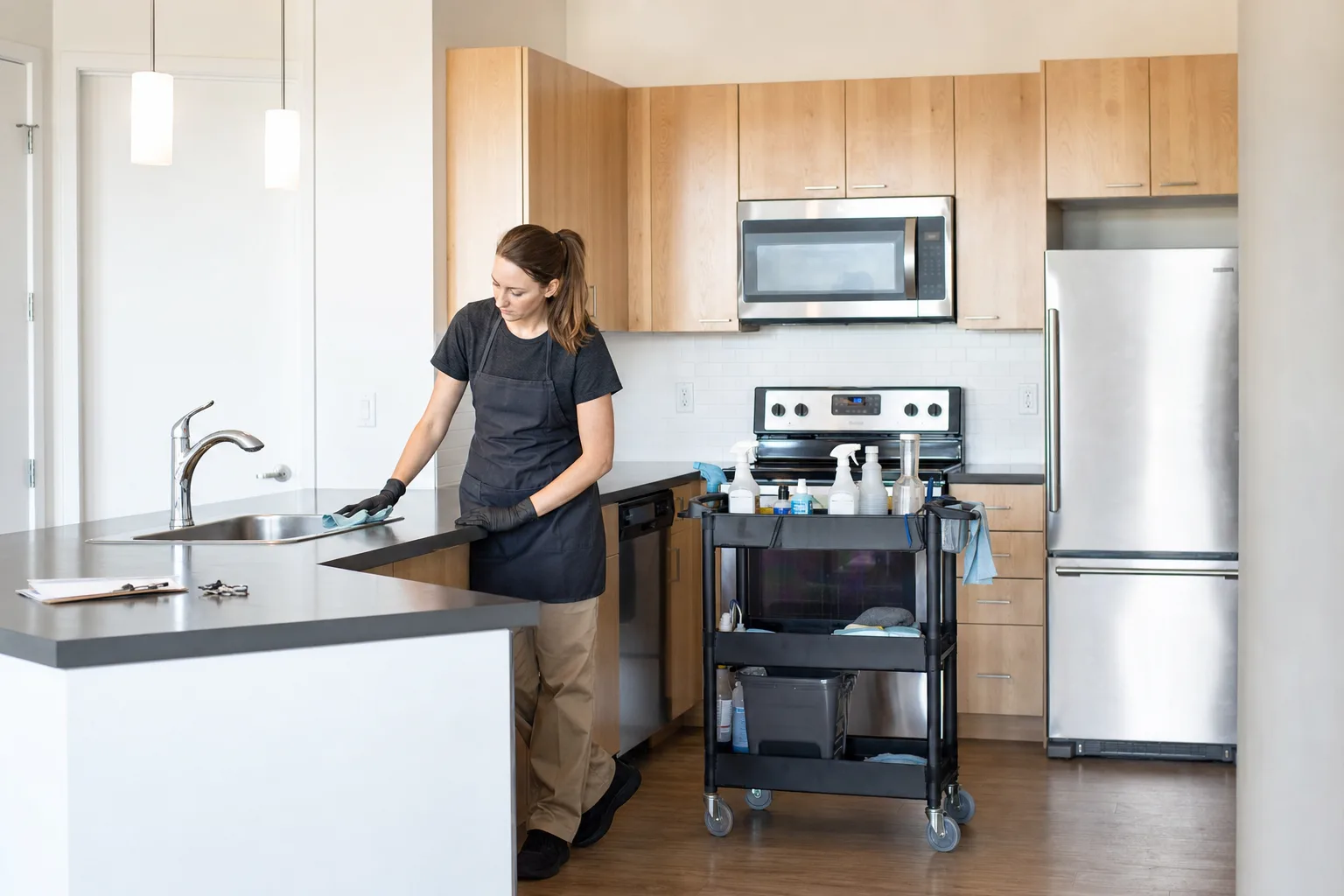
An apartment turns over as fast as its slowest sequential step. The order rarely changes: move-out inspection, repairs and paint, cleaning, floors, final check, then photos and showings. Property managers who compress the timeline do it by booking vendors before the keys come back and running the parallel tasks early. Managers who stretch it do it by starting the clock the day the unit goes empty.
The Tidy Sister handles the cleaning step of this sequence for Gresham rental owners, in between our regular house cleaning visits, so we see turnovers from the inside: the ones that hum, and the ones that stall. This is the anatomy of both.
What are the steps of a turnover, in order?
- Notice arrives. The timeline starts here, not at key return. Everything you schedule during the notice period is vacancy you never pay for.
- Pre-move-out walkthrough. Walk the unit while the tenant still lives there, scope the likely repairs, and tell the tenant what a clean handback looks like.
- Keys back and move-out inspection. Document condition with photos, room by room, appliance interiors included.
- Repairs and paint. Patch, replace, touch up or repaint. All the dust-making work happens now.
- Turnover cleaning. The whole unit, top to bottom, after the last contractor leaves.
- Carpet and floor work. Extraction or refinishing where needed, with drying time respected.
- Final walkthrough. Check the unit as a tenant would: switches, smells, tracks, appliance interiors.
- Photos, listing, showings. Shoot the unit clean and bright, and start the schedule of tours.
Notice how late the photos come. Managers who shoot the listing before the clean, or recycle photos from three tenancies ago, book tours into a unit that cannot match its own pictures, and the mismatch shows up later as no-shows on signing day.
Two clocks run underneath all of this. The vacancy clock, which is money, and Oregon’s deposit accounting deadline, which runs on calendar days and does not pause for a slow vendor.
Why does cleaning come after repairs and paint?
Because construction undoes cleaning, every time. Patching drywall produces the finest dust in the trades, and it drifts onto every horizontal surface in the unit, including the insides of cabinets that were already wiped. Paint work adds overspray, drips, and a parade of boots through the entry. Clean first and you pay for the same clean twice.
The same logic covers deliveries. If a new refrigerator or range is coming, get it delivered, unboxed, and hauled-away before cleaning day, because appliance cardboard sheds packing dust and styrofoam crumbs across a finished unit with remarkable efficiency.
The right order is dust-making work, then dust removal, then nothing. After the cleaning pass, the only people in the unit should be the person doing the final check and the prospective tenants touring it. Every trade visit after cleaning day subtracts from cleaning day.
What can run in parallel, and what cannot?
The compressible part of a turnover is almost entirely in the overlaps. Here is the honest split:
| Task | Parallel or sequential? | Why |
|---|---|---|
| Booking vendors and cleaners | Parallel, during the notice period | Scheduling needs a date, not an empty unit |
| Listing copy and marketing prep | Parallel | Everything except the photos can be drafted early |
| Rekeying and lock work | Parallel with repairs | No dust, no conflict with other trades |
| Repairs and paint | Sequential, before cleaning | They generate the dust the cleaning removes |
| Turnover cleaning | Sequential, after the last contractor | One pass only works if nothing follows it |
| Carpet extraction | Sequential, after cleaning, plus drying time | Wet carpet blocks the final walkthrough and showings |
| Listing photos | Sequential, last | The unit only looks like this once |
What compresses the timeline?
Anticipation, mostly. The pre-move-out walkthrough is the highest-value hour in the whole process, because it converts surprises into scheduled work. A manager who knows in week one of the notice period that unit 4 needs paint and a carpet extraction can have both vendors booked for the day after key return.
The tenant’s own effort matters more than most managers expect. A tenant who follows a real move-out cleaning checklist hands back a unit that skips straight to touch-up work, and a pre-move-out conversation that sets that expectation costs nothing. So does keeping one cleaning company on call: a slot held for the week keys return beats collecting bids while the unit sits empty.
If you self-manage a single rental, the same principle scales down. Your version of the held slot is one phone call the day you receive notice, and your version of the pre-move-out walkthrough is a friendly visit with a notepad three weeks before the lease ends.
The fastest turnovers are won before the old tenant returns the keys. The slowest ones begin the day after.
What stretches a turnover out?
The same things, inverted, plus a few classics. Surprise damage found at inspection, because nobody walked the unit early. Smoke or pet odor, which turns a standard clean into remediation with wall washing and carpet work. Sequencing mistakes, like a cleaning booked before the painter finished. Vendor gaps, where each trade waits days for the next opening. And the calendar itself: end-of-month and summer moving season stack every landlord’s requests into the same weeks, in Gresham as everywhere else.
Odor deserves special respect in the schedule. It is the stretch factor managers underestimate most, because it is invisible in photos and impossible to show through. Budget real time for it whenever the inspection nose says so.
Hold a standing turnover slot
Property managers who work with The Tidy Sister can line up the cleaning the day a tenant gives notice, not the week after keys return. Quotes are free and scoped per unit, and answers usually come back within a business day.
Where does the deposit deadline fit into all this?
Quietly, underneath everything. Oregon requires landlords to return a tenant’s deposit or send a written, itemized statement of any deductions on a deadline measured in calendar days, and that clock does not pause while you wait for a vendor. The good news is that a well-run turnover produces the accounting almost as a byproduct: the move-out inspection photos document condition, the repair and cleaning invoices document cost, and the itemization writes itself from the pile.
The managers who scramble are the ones who let the turnover drift and then reconstruct the paperwork from memory in week four. Run the sequence promptly, save every invoice as it arrives, and the deadline stops being a separate task at all.
What should be ready before the cleaners arrive?
Cleaning day goes fastest when five things are true: the unit is completely empty, the repairs are done, the paint is dry, the power and water are on, and someone has flagged the known problem spots. Hot water is not optional; neither is light. A cleaner working a dim unit with cold taps is doing half a job at full length.
Arrange access ahead of time too. A lockbox code or a key handoff settled the day before saves the crew an hour in the parking lot and saves you a phone call at eight in the morning.
Tell your cleaning company what the inspection found. Years of hood grease, a fridge that needs its shelves soaked, a tub with mineral crust: these change the time and the quote, and finding them on arrival instead of in advance is how a one-day clean becomes two. If you want a picture of the standard the clean should hit, our rent-ready cleaning guide for landlords describes the unit through a touring tenant’s eyes.
Heads up: cleaning companies book turnover slots the way every trade does. The week you get keys back is late to call. The day your tenant gives notice is early enough.
How does this play out in Gresham and Rockwood?
Local housing stock shapes the cleaning step more than managers expect. Rockwood’s older apartment buildings tend to mean original tubs that need serious descaling, galley kitchens where decades of hood grease concentrate in a small space, and single-pane window tracks that fill with wet-season grime. Single-family rentals off Gresham Butte or in the Hollybrook ranches run bigger: more bathrooms, more window tracks, garages that collect a tenancy’s worth of leavings.
Season matters here as well. An end-of-June turnover in Gresham competes with every family move and student lease on the Eastside, while a January turnover competes mostly with the weather. If your lease endings cluster in summer, early booking stops being a nicety and becomes the whole strategy.
None of this changes the sequence. It changes the time the cleaning step needs, which is why we quote each turnover from the unit’s actual size, condition, and scope instead of a flat rate. A scoped quote given during the notice period is itself a scheduling tool: it tells you exactly how many days to reserve between paint and photos.
The bottom line on turnover speed
The sequence is fixed: inspect, repair, paint, clean, floors, check, shoot, show. The speed is not. It is decided by how much of the work you schedule during the notice period, how cleanly the trades hand off to each other, and whether the cleaning slot exists before the unit is empty. If you manage rentals on the Eastside, The Tidy Sister offers apartment turnover cleaning in Gresham, woman-owned, insured, and licensed since 2015, with free quotes and priority scheduling for standing clients.


