
How often you should deep clean depends on who lives in your house and what happens between deep cleans. A home with pets, kids, or allergy-sensitive people collects buildup faster than a quiet adults-only household. Many cleaning professionals treat a seasonal deep clean as a sensible starting point, then adjust from what the home actually shows. And homes on a recurring cleaning schedule need full deep cleans far less often, because maintenance visits stop buildup from compounding.
Why is there no single right answer?
Because what happens between deep cleans matters as much as the deep cleans themselves. A home with steady recurring house cleaning holds its baseline week after week, so the deep clean shrinks into an occasional top-up. A home cleaned in sporadic bursts drifts downward between them, and the deep clean carries the entire load alone. Same square footage, completely different schedule.
Then there is the household itself, because homes do not get dirty at the same rate, and pretending otherwise produces advice nobody can use. The variables are concrete: how many people live there, whether shoes come off at the door, how much frying happens in the kitchen, whether a dog spends rainy afternoons in the yard, whether anyone in the house reacts to dust. A retired couple who cook lightly and wipe as they go might genuinely coast for a long stretch. A family of five with a Labrador is running a small commercial operation and should plan accordingly.
What actually builds up between deep cleans?
It helps to know what you are scheduling against, because buildup is quiet and specific:
- Kitchen film. Cooking sends a fine mist of grease drifting onto cabinet tops, upper doors, and the hood. It lands invisibly, then holds dust like flypaper.
- Minerals and soap scum. Every shower deposits a little of each. Individually invisible, collectively a crust on the faucet base and a haze on the glass.
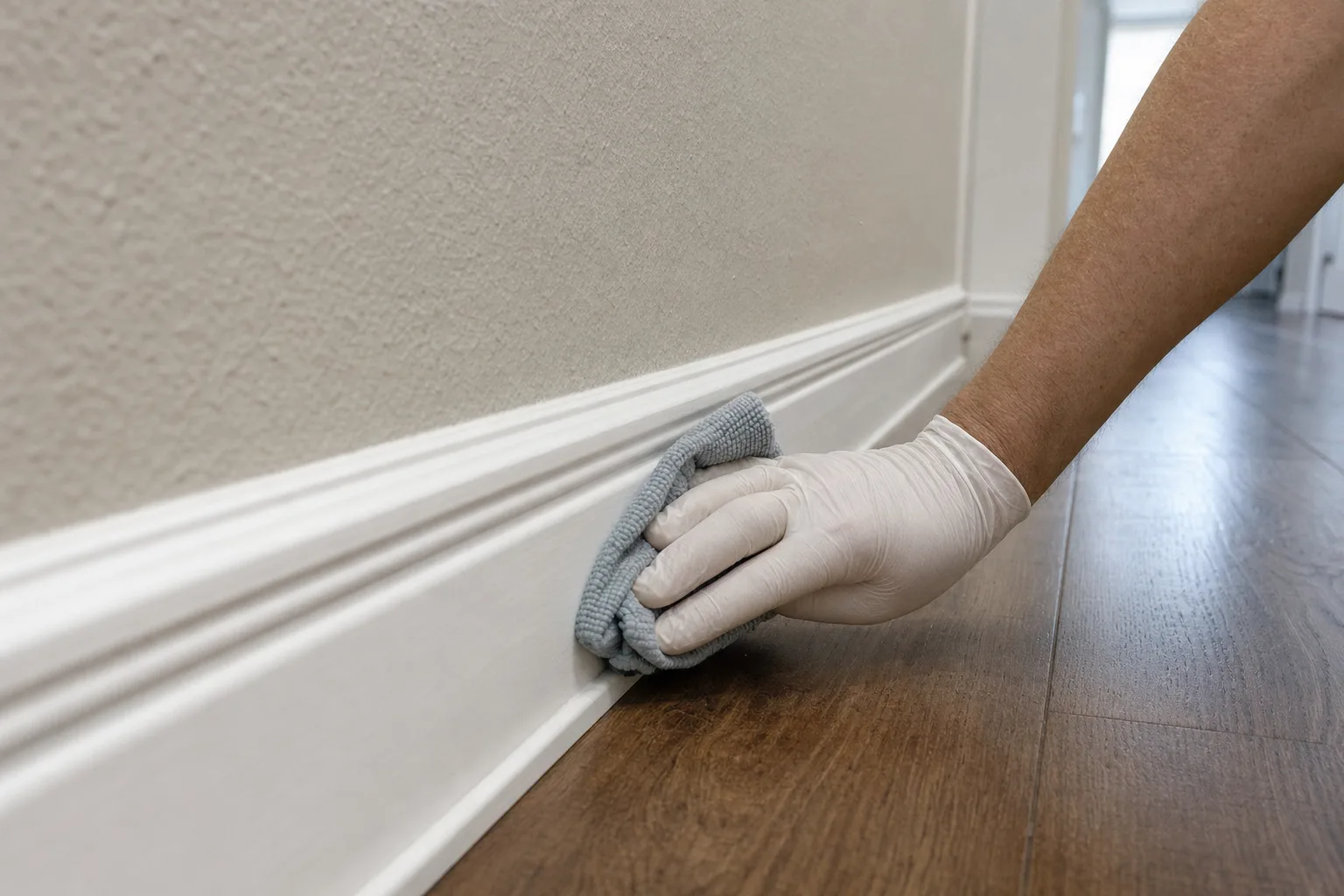
- Edge dust. Open surfaces get dusted; trim, vents, fan blades, and baseboards do not. They become reservoirs that re-dust the room within days.
- Tracked grit. Whatever the sidewalk carries comes in on shoes and settles along floor edges and in entry corners where routine vacuuming rarely reaches.
- Fabric load. Mattresses, sofas, curtains, and rugs quietly absorb dust, dander, and odors year-round.
None of these announce themselves. They accumulate below the threshold of notice until one day the window track is black and the faucet has a collar. Deep cleaning on a rhythm keeps each of them from ever reaching that point.
How do pets, kids, and allergies change the math?
Directly and unavoidably. Pets shed dander and hair that drift under furniture and into fabric; anyone who has moved a sofa in a two-dog household has met the drifts personally. A wet-season dog in the Pacific Northwest adds paw-borne mud to every entry and hallway on top of that. Kids press fingerprints onto walls and switches at exactly the height adults never look, ferry crumbs to improbable places, and multiply laundry’s dust output with every load of play clothes. Allergy-sensitive households feel buildup soonest of all: the fabric and edge-dust reservoirs that a deep clean clears are precisely where allergens settle, so those homes usually benefit from shorter intervals. To be clear about what cleaning can honestly promise: it reduces the allergen buildup in a home, which sensitive people often appreciate. It treats nothing, and no cleaning schedule should be sold as medicine.
Buildup does not care about the calendar. It cares about cooking, pets, foot traffic, and how long since anyone knelt down at the baseboards.
What cadence makes sense for your household?
Take this table as starting points, not rules. Watch your own edges and adjust; the house will tell you if you listen.
| Household | A sensible starting point | What moves it sooner |
|---|---|---|
| Adults only, shoes off, light cooking | A once-or-twice-a-year reset | Heavy frying, a wood stove, frequent guests |
| Busy family with kids | Roughly each change of season | Crawling babies, sports seasons, a busy open-door summer |
| Home with shedding pets | Seasonal, weighted toward wet months | Multiple animals, a dog with yard access, light-colored floors |
| Allergy-sensitive household | Shorter intervals than comfort alone would suggest | Pollen season, pets, wall-to-wall carpet |
| Wood heat or a smoker in the home | More frequent than any category above | Winter burning season, closed windows |
| Home on recurring professional cleaning | Rarely as a full project | Moves, renovations, a new pet, a long service pause |
Overdue and ready to hand it off?
If your home’s edges are past what a free weekend can fix, we can reset it. Free customized quotes built on your home’s actual size and condition, with most people hearing back within one business day.
How does a recurring cleaning schedule change things?
It changes the question entirely. Recurring visits keep the middles of rooms permanently at baseline, and a good service rotates detail work through its visits, so buildup never compounds. That is why recurring clients rarely book full deep cleans: there is nothing to dig out of. The deep clean becomes a one-time entry fee, paid at the start so maintenance has a clean baseline to hold, and after that the calendar mostly takes care of itself.
Households without recurring service carry the whole load with periodic resets, which works fine as long as the resets actually happen. The failure mode is drift: skip one season, then another, and the next deep clean has quietly doubled in size. If you are weighing the two approaches, the differences are laid out plainly in our guide to what separates deep cleaning from regular cleaning.
Does deep cleaning more often actually save work?
Yes, and the reason is that buildup does not accumulate at a steady price. Fresh kitchen film wipes off with a damp cloth; the same film six months later has hardened into a varnish that needs degreaser and dwell time. A thin ring of minerals at the faucet base polishes away in a minute; a season of layers becomes a crust that has to be dissolved. Grout, soap scum, and edge dust all follow the same curve, where the removal cost grows faster than the calendar does.
That curve is the real argument for a rhythm. Deep clean often enough and every session stays in the easy, cheap stage of the curve, whether the currency is your Saturday or a professional’s scoped visit. Wait until the house is loudly overdue, and you pay the compounded rate. The schedule matters less than never letting anything reach the expensive stage.
What are the signs your home is due?
Forget the calendar for a moment and audit the house instead. Walk it in daylight, with the eyes of a guest rather than a resident, because residents stop seeing their own buildup within weeks of it arriving. Any two of these means you are due:
- Baseboards and floor corners have gone gray or grown a soft fuzz
- Window tracks show black grit or speckles of mildew
- The cabinet strip above the kitchen handles feels faintly tacky
- A white crust rings the faucet base, or the showerhead sprays crooked
- Dust returns within a day or two of dusting
- The bathroom fan whistles or shows a gray mat of lint
- A room smells like fabric rather than like nothing
The finger test settles close calls: run a finger along the top of a door or picture frame. If it comes back gray, the reservoirs are full, and the reservoirs are exactly what a deep clean exists to empty.
The honest version: almost nobody deep cleans on the schedule the internet recommends, and homes survive anyway. The point of a cadence is to keep the slow, expensive buildup (grease film, mineral crust, fabric load) from ever getting entrenched, because entrenched is where the cost lives, in hours or in dollars.
Does living in the Pacific Northwest change the schedule?
Somewhat, and in a specific direction: our buildup is seasonal. The long wet season sends mud, grit, and fir needles through every entry from October onward, while windows stay shut for months and indoor dust settles undisturbed. Damp air feeds mildew in window tracks and bathroom corners the whole time, and homes heated with wood add a winter’s worth of fine ash to the dust load. Then spring pours pollen over every sill just as the windows finally open. Homes here often do well with resets timed to the seasons’ seams: one when the rains taper and the house can finally air out, and one in early fall, before the doors close and the long indoor season locks everything in. Households that anchor on the spring side can work from our room by room deep cleaning checklist and simply weight it toward tracks, entries, and fabric, which is where an Oregon winter actually lands.
The bottom line: watch the edges, not the calendar
How often to deep clean is a judgment call, and now you own the judgment: count the people and pets, watch the baseboards and tracks, and let a recurring schedule shrink the question if you want it shrunk. When the house says it is due, our deep cleaning service in Gresham and the surrounding Eastside can handle the reset. Call 503-666-2255 or text 503-875-1189 for a free customized quote; The Tidy Sister has been woman-owned, licensed, and insured since February 2015.


