
A clean workplace changes two things you can see and one you can feel. Shared surfaces (door handles, breakroom taps, restroom fixtures, the coffee pot) collect and pass along whatever the day’s hands bring in, so cleaning them removes transfer points for germs. Visible order tells employees the place they spend forty hours a week is worth maintaining. And visitors read a lobby in seconds. None of this needs inflated statistics to matter, and this post will not use any.
That last sentence is a deliberate promise. The internet is thick with suspiciously precise claims about productivity gains and sick day reductions, usually traced to a study nobody can find, quoted by someone selling commercial cleaning. We sell commercial cleaning too. So instead of borrowed numbers, here is the honest mechanical case for a clean workplace, which turns out to be strong enough on its own.
How do germs actually move through an office?
On hands, mostly, and hands are relentless. One person arrives carrying a cold. Over the morning they touch the entry door, the coffee carafe, the fridge handle, the copier screen, and the restroom faucet. Every colleague who follows touches the same spots, then touches their own face, phone, and lunch. The office kitchen concentrates the problem: a sponge that never dries, a tap everyone grips with unwashed hands, a fridge handle touched before and after food.
Cleaning intervenes at the transfer points. Disinfecting the handles, taps, buttons, and counters that dozens of hands share breaks up the relay race, and doing it daily matters because the surfaces are recontaminated daily. What cleaning cannot do is stop the coughing coworker two desks away or substitute for people washing their hands. It removes one layer of a layered problem, which is exactly how it should be described.
Frequency is the quiet variable. A handle wiped Monday is a handle recontaminated Tuesday morning, which is why high touch cleaning belongs on a daily rhythm while carpet shampooing can wait for a season. Matching each task to its own clock is most of what separates a professional schedule from a well meaning one.
Why won’t we quote you a sick day statistic?
Because we would be guessing with someone else’s confidence. How much workplace illness traces back to surfaces varies with the bug, the season, the building, and the habits of the people in it, and outcomes differ from one workplace to the next. A cleaning company quoting you a precise percentage is doing marketing, not science.
We clean offices for a living and we still will not promise you fewer sick days. The mechanism is real; the percentage is somebody’s marketing.
Here is what can be said plainly: shared surfaces demonstrably carry germs, cleaning demonstrably removes them, and an office where restrooms, kitchens, and high touch points get daily attention gives illness fewer places to sit and wait. Pair that with the policies that do the heaviest lifting, meaning handwashing and letting sick people stay home, and cleaning takes its proper place: a sensible, checkable part of the system rather than a magic number. It also keeps expectations honest, which is where good client relationships start.
A local note: the case is strongest here from October through April. Gresham winters push everyone indoors with the windows shut, wet coats on shared racks, and the same door handles between every meeting. Indoor season is when surface cleaning earns its keep.
What does a visibly clean office signal to your team?
People calibrate to the room. In an office where the microwave is crusted and the restroom is an afterthought, nobody feels foolish leaving dishes in the sink, and standards slide together. In a space that is visibly maintained, small slobbery stands out, so people correct it themselves. Every shared space runs on this loop; the only question is which direction yours spins.
The signal runs deeper than tidiness. The state of the staff restroom is one of the clearest messages a company sends about how it values the people who cannot choose a different one. Same for the breakroom: employees notice whether the place they eat lunch is treated like a room that matters. None of this shows up on a spreadsheet, and all of it shows up in how people talk about their employer.
There is a hiring angle too. Candidates tour your office with the same eyes your clients use, and the people you most want to hire have options. A workplace that looks after itself makes a quiet promise about how it looks after people, and candidates weigh that promise whether or not they could tell you they are doing it.
What do clients and visitors read in the first minute?
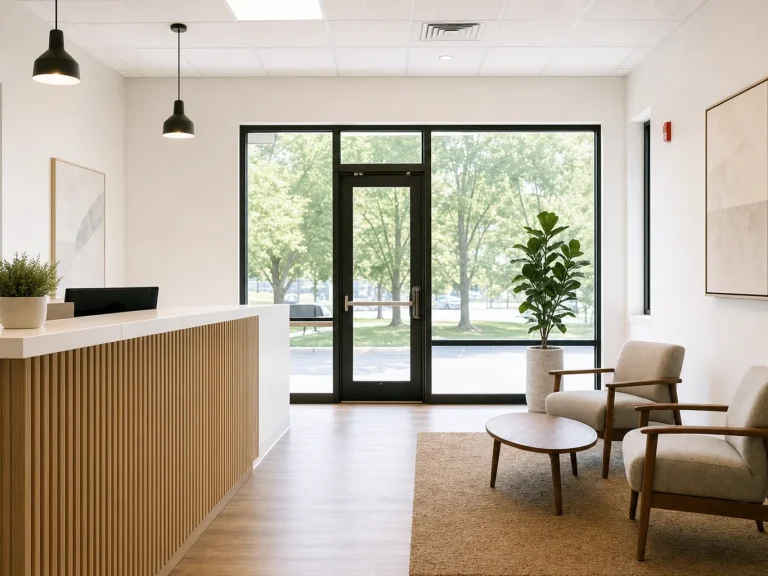
Smell first, before the door finishes closing: coffee and clean floors tell one story, old carpet and overflowing bins another. Then the sightlines: entry glass at hand height, carpet traffic lanes, the reception counter, dust on the sill beside the waiting chair. And if a visitor uses your restroom, that room quietly becomes the whole review.
Visitors extend what they see to what they cannot. A prospective client who notices grime in the lobby will wonder, fairly or not, about the rigor of the work you would do for them. The reverse is also true, which makes the entry sequence the highest leverage cleaning money a client facing business spends. If you want to see how those front of house tasks slot into a full routine, our office cleaning checklist for daily, weekly, and monthly tasks breaks the whole building into tiers.
Run the test on your own building tomorrow morning. Walk in through the public entrance, slowly, and let yourself notice what a stranger would: the glass, the smell, the mat, the sightline to the first desk. Most managers have not entered through their own front door in months, and the building saves its honest opinions for exactly that route.
Want your office to make this case for you?
The Tidy Sister keeps Gresham workplaces clean on schedules built around real traffic and real budgets. Quotes are free and customized, and most people hear back within one business day.
If the budget covers one thing, what should it be?
Restrooms plus high touch surfaces, cleaned daily. Everything else can flex; these two cannot, because they carry the most germs and the most judgment per square foot. A priority ladder for tight budgets:
| Priority | What it covers | Why it ranks here |
|---|---|---|
| 1. Restrooms | Fixtures, counters, floors, restocking, daily | Highest germ traffic and harshest judgment in the building |
| 2. High touch surfaces | Handles, switches, shared equipment, daily wipe downs | The transfer points where hands trade germs all day |
| 3. Breakroom and kitchen | Counters, sink, appliance exteriors, trash | Food plus shared hands, where neglect grows fastest |
| 4. Floors and entry glass | Traffic lanes, mats, lobby sightlines | What visitors see before anyone says hello |
| 5. Detail work | Dusting, vents, baseboards, blinds, on rotation | Matters over months rather than days |
Budgets stretch further than most managers expect when scope is ranked like this, because the expensive mistake is buying uniform mediocrity across the whole list instead of excellence at the top of it. What each tier costs to hand off is covered in how office cleaning is priced in Gresham.
The ladder also gives you an honest way to grow the service. Start with tiers one and two on a daily rhythm, watch what the building does for a month, then add the breakroom or floors when the budget breathes. Scaling up a schedule that works beats launching a grand one that gets cut at the first hard quarter.
How does morale show up day to day?
In small, specific frictions that either exist or do not. Whether someone hesitates before the breakroom fridge. Whether the conference room smells fine when the door has been shut all weekend. Whether the good meeting chairs are the ones nobody wants to touch. Whether the last person to make coffee had to clean someone else’s cup first.
Each is trivial alone. Stacked across a week they set the ambient answer to a question every employee asks without asking: does anyone care how it feels to work here? A cleaning schedule is one of the few management tools that answers daily, physically, and without a memo. It is also one of the few where employees notice the change within a week of it starting, and notice faster when it stops.
Managers sometimes learn this the hard way after trimming a cleaning schedule to save money. Nothing visible changes for a week or two. Then the fridge conversation happens, the restroom comments start, and someone tapes up a passive aggressive sign about dishes. Signs about dishes are the check engine light of workplace morale: cheap to ignore, expensive to keep ignoring.
The bottom line on clean workplaces
Skip the borrowed statistics; the honest case is enough. Daily cleaning strips germs from the surfaces everyone shares, visible order sets the standard people match, and your lobby negotiates with visitors before you do. Start with restrooms and high touch points, add tiers as budget allows, and put it on a schedule instead of a mood. The Tidy Sister has been woman owned, licensed, and insured since February 2015: ask about commercial cleaning in Gresham by calling 503-666-2255 or texting 503-875-1189 for a free customized quote.