
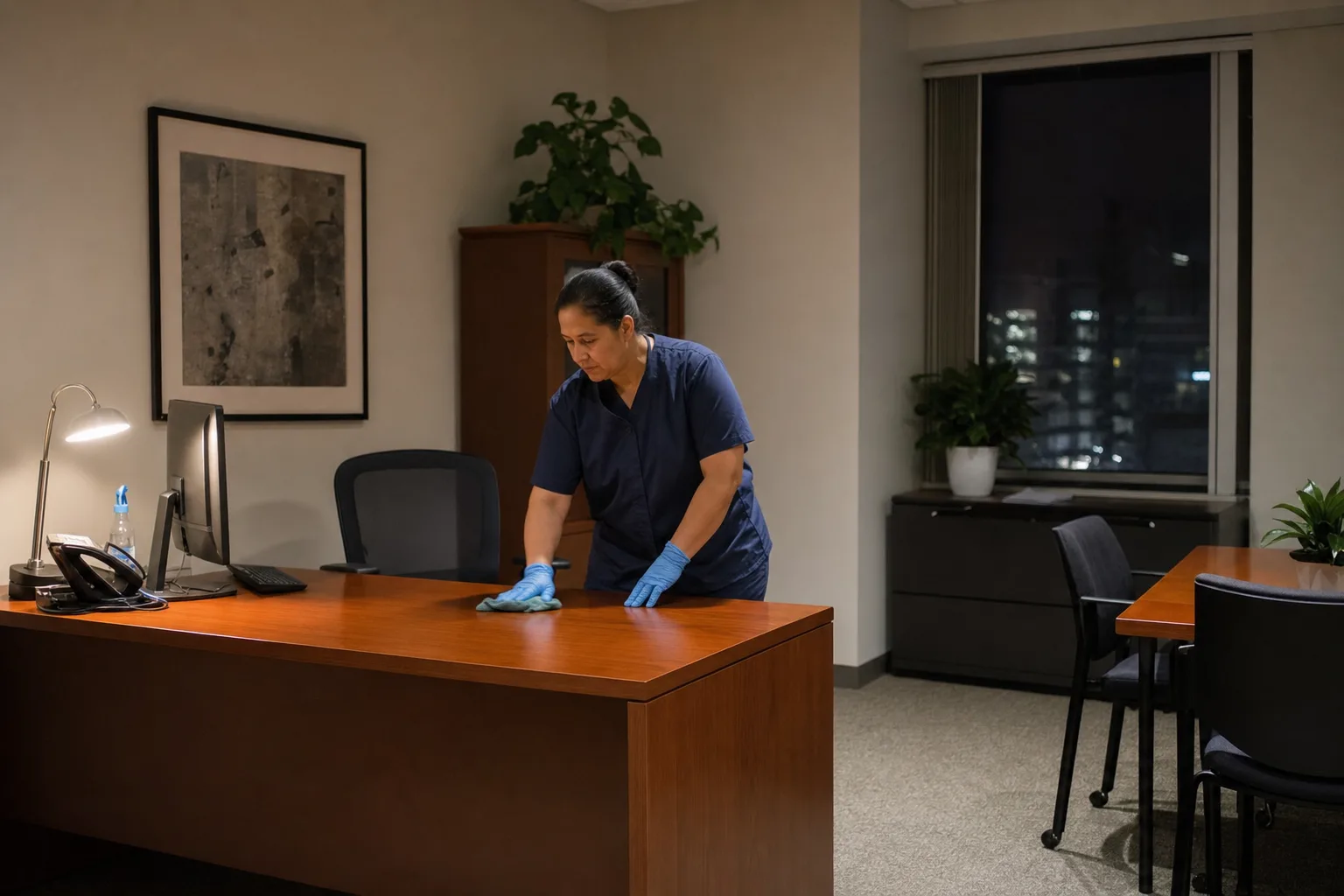
An office cleaning checklist works in three tiers. Daily tasks cover what hands touch and germs travel on: door handles, shared equipment, restrooms, breakroom counters, trash, entry floors. Weekly tasks reset the whole space: full vacuuming, mopping, dusting, interior glass. Monthly tasks reach what nobody notices until a client does: vents, baseboards, light fixtures, high shelves. This guide lays out all three tiers in full, then shows how to bend the list to fit your building.
Walk through most small offices around Gresham and the problem is rarely effort. Someone wipes the breakroom counter when it bothers them, the front desk keeps a canister of wipes in a drawer, and the restroom gets real attention only when an important visitor is due. A written checklist, whether your own staff run it or a commercial cleaning company carries it, replaces mood with a system. Here is the list we would hand you.
Why does an office cleaning checklist need three tiers?
Dirt runs on three clocks. Germs move daily: every handle, keyboard, and coffee pot collects whatever hands brought to work that morning. Visible soil builds weekly: carpet traffic lanes flatten and gray, glass smudges, monitor stands grow a soft felt of dust. Buildup creeps monthly: vents fur over, baseboards dull, and the fixture above the conference table slowly fills with shadows.
Treat all three the same and you either burn hours wiping baseboards every night or let the vents go feral while everyone argues about whose turn it is. Split the list and each task lands at the frequency where it earns its time. A tiered list also makes the real workload honest, which helps when you decide whether staff or a service should carry it. For the case that shared surfaces deserve this much attention in the first place, see our post on what a clean workplace does for sick days and morale.
What should be cleaned in an office every day?
Daily work is short, repetitive, and does the most good per minute spent. It covers four zones, every workday, whether the office looks like it needs it or not. That last part matters: high touch surfaces look identical clean or contaminated.
High touch surfaces
- Door handles, push plates, and light switches, including the back door everyone forgets
- Shared keyboards, mice, phones, and headsets used by more than one person
- Copier and printer touchscreens
- Coffee machine buttons, fridge door handles, microwave keypads
- Conference room remotes, shared pens, and tabletop edges
Restrooms
- Toilets and urinals cleaned and disinfected, seats on both sides
- Sinks, faucets, and counters wiped and disinfected
- Mirrors spot cleaned
- Paper products, soap, and seat covers restocked
- Floors swept and mopped, corners included
- Trash emptied and liners replaced
Breakroom and kitchen
- Counters and tables wiped down
- Sink emptied, scrubbed, and dried
- Appliance exteriors wiped: fridge, microwave, toaster
- Coffee station reset and drip tray rinsed
- Trash and recycling out, liners replaced
- Floor swept, and mopped whenever anything sticky says so
Entry, floors, and trash
- Entry mats vacuumed (nine months of wet Oregon sidewalks come in on shoes)
- Entry and lobby glass checked for smudges at hand height
- Reception counter and waiting area chairs wiped
- Desk side trash collected
- Traffic lanes vacuumed or dust mopped
What belongs on the weekly office cleaning checklist?
Weekly tasks reset what the daily pass walks by. This is the tier where an office starts looking cleaned rather than merely tidied, and it is the tier most offices quietly skip. If you only hand off one tier to a professional crew, hand off this one: it is big enough to matter and rhythmic enough to schedule.
- Vacuum every carpeted area edge to edge, including under desks where chairs allow
- Mop all hard floors, moving chair mats and trash cans instead of steering around them
- Dust desks, window sills, ledges, and partition tops, working around paperwork rather than through it
- Clean interior glass: sidelights, conference room walls, display cases
- Wipe chair arms and bases, the spot every sleeve touches and no one cleans
- Detail the breakroom: microwave interior, fridge handle and gasket, cabinet fronts
- Disinfect shared phones and headsets thoroughly, beyond the daily wipe
- Dust plants, frames, and decor before they announce themselves
What should be on the monthly office cleaning checklist?
Monthly work is the buildup tier. Skip it for a quarter and the office develops that tired, gray look nobody can quite name but every visitor registers.
- High dusting: air vents, ceiling corners, tops of cabinets and shelving
- Baseboards and door frames wiped
- Light fixtures and diffusers dusted
- Window blinds dusted slat by slat
- Upholstered chairs vacuumed with an attachment
- Furniture moved where practical, and the floor underneath cleaned
- Fridge interior emptied, culled, and wiped, with a named owner for the culling
- Walls spot cleaned around switches and along busy corridors
A scheduling trick that keeps this tier alive: split the monthly list across the month instead of saving it for one heroic Friday. Vents and high dusting the first week, baseboards and frames the second, blinds and fixtures the third, the fridge and furniture moves the fourth. Fifteen minutes a week beats a two hour session nobody ever starts, and the building never hits a week where every buildup task is overdue at once.
Want this checklist handled for you?
The Tidy Sister cleans Gresham offices on daily, weekly, and monthly schedules, with quotes built around your actual space and scope. Quotes are free, and most people hear back within one business day.
What falls through the cracks when staff clean their own office?
Ownership, first. A rotating chore chart survives about as long as the enthusiasm of the person who made it. Then tasks drift toward whoever cares most, that person quietly resents it, and the list dies in a drawer by spring.
The pattern in the tasks themselves is consistent too. Staff cleaned offices handle the visible middle: counters get wiped, trash goes out. What slips is everything at the edges. Phone handsets that smell faintly of other people. Restroom floor corners a quick mop pass never reaches. Vacuum lines that stop where the cord ran short. Vents, baseboards, and blinds, which belong to nobody on any chart.
Nobody owns the office fridge, so nobody cleans it. That is the whole story of staff cleaned offices in one appliance.
There is a fairness cost as well. The person doing the cleaning is doing it on top of the job they were hired for, and the rest of the office reads that arrangement clearly, even when nobody says it out loud.
Heads up: consumables are a checklist line, not an assumption. Paper towels, soap, and toilet paper run out on Friday afternoons precisely because restocking belonged to everyone. Give it a named owner, whoever does the cleaning.
How do you fit this checklist to your actual office?
The three tiers hold for almost any workspace. Where you spend the minutes should not. A quick guide:
| Office type | Weight the effort toward | Why |
|---|---|---|
| Small professional suite | Restrooms, breakroom, entry glass | Fewer hands, but every client sees the same three spots |
| Storefront with walk-in traffic | Daily entry floors, glass, reception high touch points | Wet Gresham sidewalks come inside on shoes all winter |
| Shared or coworking space | High touch surfaces, as often as you can manage | Every handle is shared by people who never meet |
| Office with a full kitchen | Fridge and microwave tasks, moved up a tier | Food mess grows faster than office mess |
Frequency and scope are also the two dials that set what professional service costs. We walk through every variable in what office cleaning costs in Gresham, but the short version applies here: the tighter your checklist, the more accurate your quote.
Should staff or a service own the checklist?
Honest answer: it depends on traffic and follow through. A three person office with no walk-ins and one genuinely tidy owner can run the daily tier in house and bring in help for the weekly and monthly work. An office with public traffic, client meetings, or more than one restroom usually cannot keep up, because the daily tier alone is a real shift of work that repeats five times a week.
The hybrid model works well for many Gresham businesses: staff keep their own desks and dishes, a professional crew owns everything shared. Since our hours run Monday to Friday, 8 AM to 8 PM, evening visits can land after your last client leaves without anyone working around a vacuum. And because we skip bleach entirely, the office smells like nothing at all the next morning, which is the goal.
One test worth running before you decide: track who actually did the checklist for a month. Put initials next to each line. If the same one or two names appear every week, you do not have a staff cleaning system, you have volunteers, and volunteers burn out. If the initials rotate evenly and the restrooms still pass inspection on Friday afternoon, keep the system and spend the savings elsewhere. The initials never lie, which is exactly why the exercise gets skipped.
The bottom line on office cleaning checklists
A checklist only works when someone owns every line on it. If your team can own it, print the tiers above and start Monday. If the list keeps losing to actual work, that is normal, and it is fixable. The Tidy Sister has been woman owned, licensed, and insured since February 2015, and we clean offices as well as homes across Gresham and the Portland Eastside. Ask us about office cleaning in Gresham: call 503-666-2255 or text 503-875-1189 for a free customized quote.


