
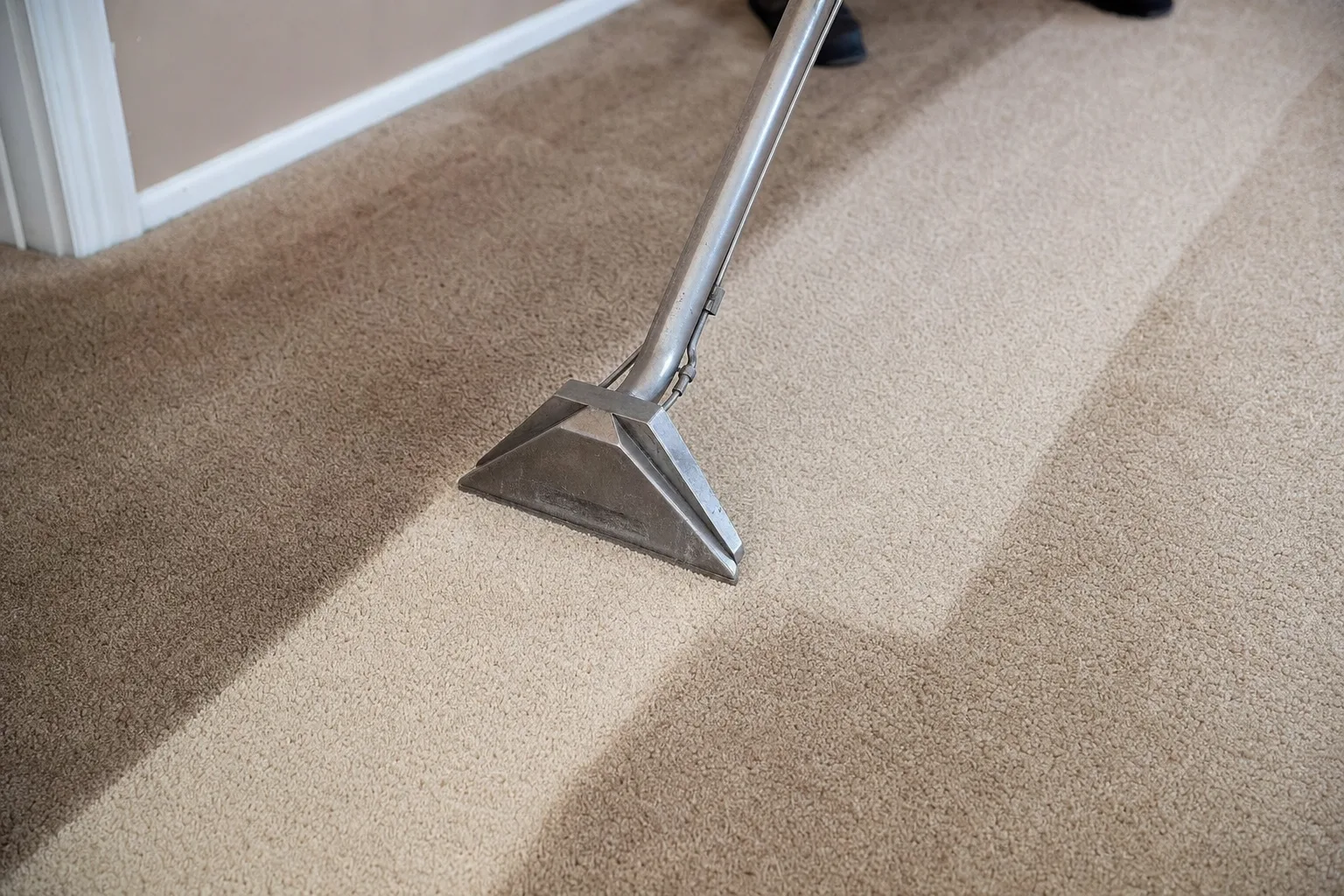
Most carpet manufacturers tie their warranties to professional cleaning on a regular schedule, commonly described as every 12 to 18 months ‹confirm: exact manufacturer warranty interval wording before publish›. Treat that as a starting point rather than a rule. Homes with pets, kids, allergies, or heavy foot traffic usually need professional extraction sooner, while a quiet adult household with a shoes off habit can often wait longer. Vacuuming maintains carpet between cleanings; it never replaces them.
That answer deserves some unpacking, because carpet hides dirt better than any other surface in a house. A wood floor shows every footprint. Carpet swallows soil quietly for months, then one day the path from the couch to the kitchen looks gray and no amount of vacuuming brings it back. Regular house cleaning keeps the visible layer under control. What builds up underneath runs on its own clock, and this post is about reading that clock for your home.
What Do Carpet Manufacturers Actually Recommend?
Check the warranty booklet that came with your carpet, or the manufacturer’s website if the booklet vanished during a move. Most major carpet brands make periodic professional cleaning a condition of keeping the texture and stain warranties valid, and many ask you to keep receipts as proof. The logic is simple from their side: embedded grit shears fibers, and a carpet that never gets deep cleaned wears out early no matter how good the yarn is.
Two practical takeaways. First, if your carpet is newish and you care about the warranty, professional cleaning is not optional, so save every invoice. Second, even if warranty coverage lapsed years ago, the interval the manufacturer names is a reasonable baseline for an average household. Averages are where the usefulness ends, though. Nobody lives in an average household, and the sections below are about figuring out where yours actually lands.
One more wrinkle worth knowing: warranty language often specifies the cleaning method as well as the timing, and it usually names hot water extraction performed by a professional. Reading those two pages once takes five minutes and can save an argument with a manufacturer later, so dig the booklet out before you need it.
Why Isn’t Vacuuming Enough?
A vacuum removes dry, loose soil sitting near the surface, and doing it weekly is the single best thing you can do for carpet life. What a vacuum cannot touch is the other category of dirt: cooking oils that settle out of kitchen air, skin oils, pet dander, spilled who knows what, and the sticky film all of that forms on fiber. That film grabs new dry soil and holds it, which is why traffic lanes turn dull and gray instead of just dusty.
Professional extraction flushes fiber with heated solution and pulls it back out under strong vacuum, taking the oily residue and the bound up grit with it. Rented machines from the grocery store work on the same principle with a fraction of the heat and suction, and the common mistake with them is over wetting: soaking the pad underneath, which dries slowly and can leave a musty smell worse than the dirt you started with.
Vacuuming keeps carpet looking clean. Extraction keeps it actually clean. Those are two different jobs on two different schedules.
Which Households Need Professional Carpet Cleaning More Often?
Here is the honest way to adjust the manufacturer baseline for real life. None of these are rules, just the direction each factor pushes.
| Household situation | Sensible starting point | Why it moves the schedule |
|---|---|---|
| Pets, especially dogs | Short end of the manufacturer range, sometimes sooner | Dander, tracked in yard soil, oils from fur, the occasional accident that soaked deeper than the surface wipe reached |
| Young kids | Short end of the range | Floor level living: snacks, spills, craft projects, and everything the stroller wheels brought home |
| Allergy sensitive household | Short end, paired with weekly HEPA vacuuming | Carpet holds dander, pollen, and dust; extraction lowers the buildup that vacuuming leaves behind |
| Adults only, shoes off at the door | Long end of the range is usually fine | Less tracked in soil and less oil transfer means the film builds slowly |
| Rental property | At every tenant turnover | A documented professional cleaning between tenants protects both parties and resets the wear clock |
If two rows describe your house, lean toward whichever is sooner. A dog plus a toddler is not a coin flip.
Does the Pacific Northwest Change the Math?
It does, and anyone who has lived through a Gresham January knows why. From roughly October to May, everything that enters your home enters wet. Wet shoes pick up fine soil and deposit it deep in carpet pile instead of dusting the surface the way dry summer dirt does. Add fir needles, moss grit off the walkway, and the particular mud that Johnson Creek neighborhoods produce, and the first ten feet inside every exterior door works harder here than in most of the country.
A local note: the wet season is why entry carpet in Portland area homes ages faster than bedroom carpet in the same house. Long mats outside and inside every door, plus a genuine shoes off habit, will do more for that stretch of carpet than any product you can buy.
If the rest of your main floor is wood, the same wet season slop is quietly working on it too. Our guide to hardwood floor cleaning do’s and don’ts covers what tracked in grit does to a harder surface.
How Can You Tell a Carpet Is Overdue?
Carpet rarely announces the problem. It just slides. Watch for these signs:
- Traffic lanes stay gray or matted after a slow, careful vacuuming.
- The color looks flat compared to the strip of carpet hiding under the couch.
- A musty or doggy smell shows up on humid days, then fades when the house dries out.
- Sitting on the floor starts the sniffles for the allergy prone person in the house, a sign of allergen buildup in the pile.
- You rent a machine, run it over one room, and the recovery tank water comes back the color of coffee.
Any one of these means you are past due, not approaching it. Carpet that gets cleaned before it looks bad keeps its texture far longer than carpet rescued after the fact, because the grinding damage from embedded grit happens continuously between cleanings, not all at once at the end. Waiting for visible failure means the fibers already lost the fight.
Not sure if your carpet is due?
Describe what you are seeing, the traffic lanes, the pets, the last cleaning you remember, and we will give you an honest read and a free customized quote. Most people hear back within one business day.
What Counts as Professional Cleaning, and What Doesn’t?
The word professional is doing real work in the manufacturer guidance. Warranty language typically expects hot water extraction performed with commercial equipment, not a rented unit run across the living room on a Saturday. The professional version brings water heated far beyond what a rental manages, much stronger vacuum recovery so carpet dries in hours instead of days, and someone who knows the difference between wool, olefin, and nylon before the first pass.
Rental machines still have a place: a fresh pet accident, one sad hallway, a between cleanings refresh. Just treat them as spot support, keep the passes light, and go slow on the vacuum stroke so the machine recovers most of what it laid down. What rentals cannot do is reset a whole carpet, and stretching one to that job usually ends in stiff, slow drying pile.
A note on timing your first professional cleaning for new carpet: there is a persistent myth that cleaning new carpet too early ruins it, left over from the era of soap heavy shampoo methods that left sticky residue behind. Modern extraction done properly does not have that problem. Clean the carpet when it needs cleaning, whatever its age, and let the condition rather than superstition set the date.
Can You Stretch the Time Between Professional Cleanings?
Yes, with habits that cost almost nothing:
- Mats on both sides of every exterior door, long enough for two full steps.
- Shoes off inside, or at minimum a hard rule during the wet months.
- Weekly vacuuming at a slow pace, with an extra pass on traffic lanes. Fast vacuuming grooms the surface and leaves the grit.
- Blot spills the hour they happen. Anything that dries into the pile becomes a project.
- Shift furniture a few inches once in a while so traffic paths vary.
None of these habits replace extraction, but together they can honestly move a household from the short end of the range toward the middle. The vacuum habit matters most. A carpet that gets a slow weekly vacuum holds dramatically less abrasive grit than one that waits for company to visit, and less grit means the oily film has less to bind.
Carpet is also only one of the soft surfaces in your home quietly collecting allergens. Your bed gathers its own share every night, and our guide to mattress cleaning and dust mites covers what genuinely helps there and what is mostly theater.
The Bottom Line on Carpet Cleaning Frequency
Start with your manufacturer’s interval, then adjust for the life happening on top of the carpet: pets and kids move the date up, a quiet shoes off household moves it back, and a Pacific Northwest wet season argues for cleaning in spring once the mud stops arriving. When the traffic lanes stop responding to the vacuum, the carpet has already voted. The Tidy Sister has been woman owned, licensed, and insured since February 2015, and we are glad to talk through professional carpet cleaning in Gresham for your home. Call 503-666-2255 or text 503-875-1189 for a free customized quote.


