
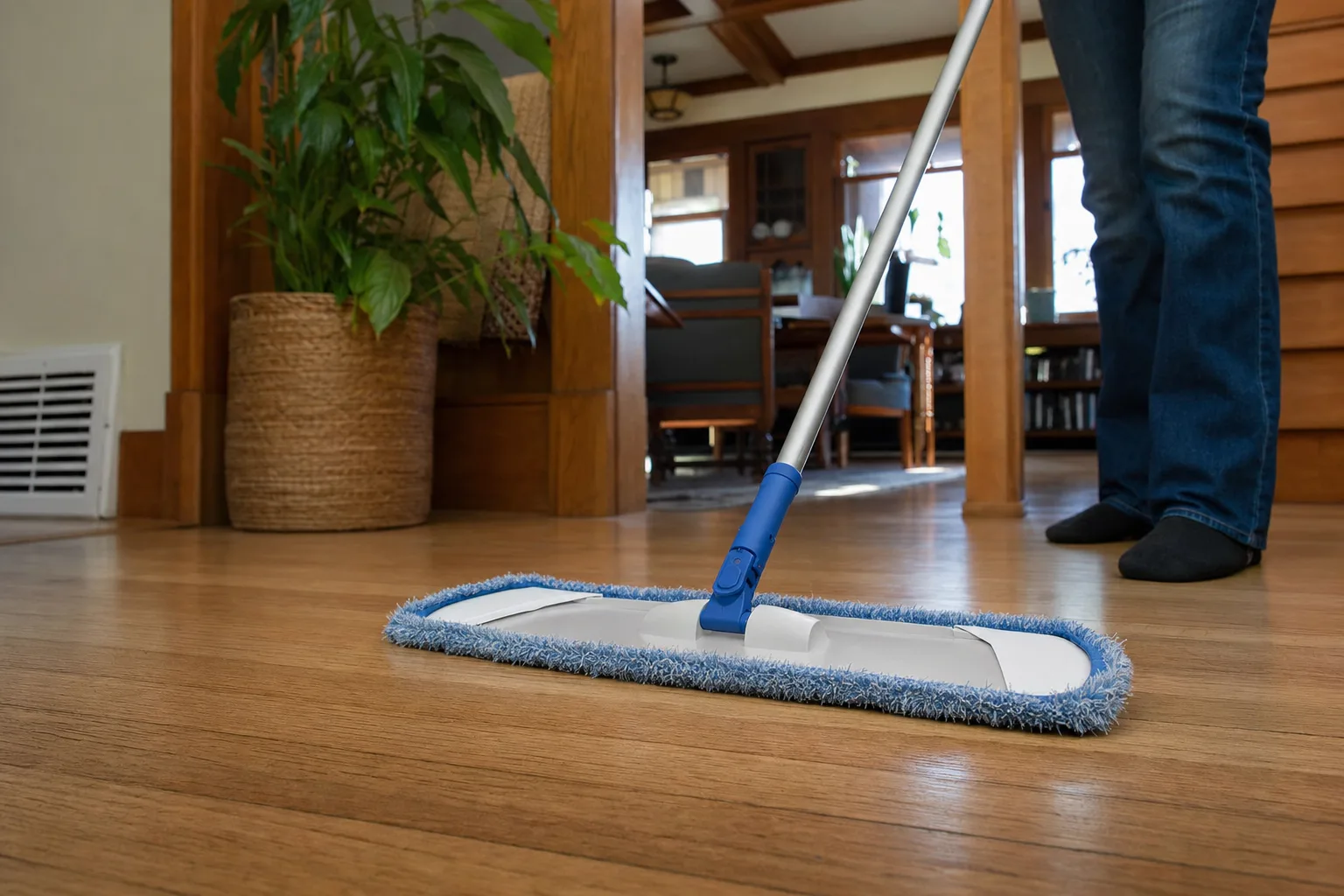
The safe routine for hardwood is short: remove grit first with a soft broom or a vacuum with the brush roll off, then follow with a barely damp microfiber mop and a cleaner made for your floor’s finish. What ruins finish is grit, water, and the wrong products, roughly in that order. Steam mops, soaking wet string mops, and acidic or oily cleaners cause the kind of damage that no future cleaning can undo.
Gresham has a lot of wood floors worth protecting. The Craftsman houses near Main City Park still carry oak laid a century ago, and plenty of newer homes on the Butte have engineered planks with a factory finish that behaves differently than old site finished wood. When we quote house cleaning for these homes, the floors are usually the first thing the owner brings up, and fair enough. Here is how we think about them.
What’s the Right Way to Clean a Hardwood Floor?
Dry first, damp second, never wet. That is the whole philosophy.
Dry means getting grit off the floor before anything touches it with moisture: a soft bristle broom, a dust mop, or a vacuum with the beater bar switched off. The beater bar matters because a spinning brush flings grit across the finish like a tiny sandblaster on wheels.
Damp means a flat microfiber mop wrung out until it feels almost dry, with a pH neutral cleaner made for sealed wood. Spray the cleaner onto the pad rather than the floor so no puddle ever forms, work with the grain, and the floor should be dry within a minute of the mop passing. If you can see standing moisture behind you, the mop is too wet. Swap or rinse pads as they load up; a dirty pad just relocates the grime in gray streaks.
Never wet means exactly that. No bucket sloshed across the boards, no puddle left to air dry, no soaking the corners because they looked extra dirty. Wood and water have a long unhappy history, and every rule in this post traces back to it.
Which Products and Tools Belong Nowhere Near Hardwood?
This table is the post. Print it, tape it inside the broom closet, argue about the vinegar row at dinner.
| Task | Do | Don’t |
|---|---|---|
| Dry cleanup | Soft broom, dust mop, or vacuum with the brush roll off | Vacuum with a spinning beater bar, stiff synthetic brooms that scratch |
| Mopping | Flat microfiber mop, barely damp, cleaner sprayed on the pad | String mops, buckets of water, steam mops of any kind |
| Cleaner | pH neutral cleaner made for your specific finish | Vinegar, ammonia, oil soaps, wax or shine products on polyurethane |
| Spills | Wipe the moment you see them, dry the spot fully | Letting water sit, leaving pet bowls without a mat, letting puddles air dry |
| Protection | Felt pads under furniture, breathable rug pads, mats at doors | Rubber backed rugs that trap moisture, rolling chairs with no mat, high heels on soft pine |
Why Is a Steam Mop the Fastest Way to Ruin a Wood Floor?
Steam mops are marketed as deep cleaning, and on tile they have a case. On wood, steam is pressurized moisture plus heat, which is precisely the combination wood fears most. The vapor drives into board seams and any microscopic gap in the finish, and once moisture is under the finish it has nowhere to go. The results show up as cloudy white patches, peeling finish, and cupped boards with edges that rise like potato chips. Flooring manufacturers know this, which is why steam damage is a standard exclusion in finish warranties. There is no sealed floor exception worth trusting: even a perfect finish has seams, and a floor that has lived a few years has more gaps than you can see.
The cruel part is the delay. Steam damage rarely announces itself on day one; the floor looks great after the first few sessions, which convinces people the warnings were overblown. The cupping and clouding arrive months later, after the moisture has had time to work, and by then the steam mop looks innocent. If a floor genuinely needs more cleaning power than a damp microfiber pad delivers, the answer is a better cleaner and more frequent passes, never more water and never heat.
Grit is sandpaper with a schedule. Every dry, gritty footpath across a hardwood floor is a slow sanding pass nobody asked for.
Does Vinegar Actually Damage Hardwood?
The internet fights about this one, so here is the fair version. Vinegar is a mild acid. On a healthy polyurethane finish, a well diluted vinegar solution will not melt the floor on contact; what it does over months of repeated use is slowly dull the sheen, because acid and finish are not friends even in small doses. On older, worn, or waxed finishes the risk is worse, since more of the acid reaches wood and old finish that cannot shrug it off.
The practical verdict: purpose made hardwood cleaner is inexpensive, works better, and carries no risk debate. The vinegar habit survives because it is what a lot of us watched a parent do, on floors that often had a wax finish where the rules were different anyway. Retire the habit and keep the memories.
What Actually Wears Out the Finish?
Finish rarely dies of one dramatic event. It wears out from a rotation of small insults:
- Grit. The number one finish killer. Sand and fine soil ride in on shoes and get ground in with every step.
- Water. Drips at the sink, the dog bowl splash zone, wet boots parked on bare wood, plant pots without saucers.
- Furniture. Bare chair legs and one furniture rearrangement can do more visible damage than a year of footsteps. Felt pads cost pennies.
- Sun. UV through south windows fades and ages finish unevenly; rugs and curtains slow it down.
- Wrong products. Oil soaps and shine polishes build a film that looks good for a month, then turns hazy and grabs dirt.
Notice what is missing from that list: foot traffic itself. Clean, sock footed traffic on a grit free floor does remarkably little harm. The floor is not wearing out because people live on it; it is wearing out because of what rides along with them. That distinction is the entire case for mats, felt pads, and a dry mop that actually gets used.
Floors that deserve careful hands?
We clean hardwood like the finish matters, because it does. Call or text for a free customized quote; most people hear back within one business day.
What If Your Floors Are Original to an Older Home?
Original floors in a 1920s Gresham Craftsman may not wear polyurethane at all. Many old floors carry shellac or wax finishes, and those play by different rules: water spots turn shellac white almost instantly, and modern cleaners can smear or strip wax. Two habits protect you. First, test any product in a closet corner before it meets the living room. Second, when in doubt, clean old floors with nothing but a barely damp microfiber pad and dry them immediately.
Engineered floors in newer homes sit at the other end of the spectrum and come with their own rule: the wear layer on top is thin, sometimes very thin, so aggressive cleaning and abrasive pads cost proportionally more than they would on thick solid oak. The good news is that factory finishes are tough and predictable, and the manufacturer publishes exact care instructions. Whatever the brand says beats whatever the internet says.
The honest version: cleaning maintains finish; it cannot restore finish that is already worn through. If boards have gone gray or bare in the traffic paths, that is a refinishing conversation with a flooring professional. We are cleaners, and we will tell you when a job is not a cleaning job.
How Do You Protect Hardwood Through a Gresham Winter?
From the first October rain until the roses come back, the enemy plan is simple: wet grit at every door. Counter it with long mats outside and inside each entrance, a bench or chair that makes shoe removal easy enough that guests actually do it, and an old towel stationed by the door for dog paws. Wipe drip trails promptly instead of letting the heater dry them into mineral spots.
Winter is also when the dry mop earns a promotion. The grit load coming through your doors from November to March is several seasons’ worth of summer dirt, delivered wet so it clings. Bumping the dry cleanup rhythm at entries and along the main walking routes costs a few minutes a week and saves the finish measurably by spring.
Two neighbors of this problem are worth knowing about. The same wet season slop that dulls hardwood is what darkens the grout in your entry and kitchen tile, and our guide to why grout gets dark explains the counterintuitive part: ordinary mopping makes it worse. And the area rugs guarding your wood floors collect what they intercept, so it helps to know how often carpets and rugs need professional cleaning to keep doing their job.
The Bottom Line on Keeping Hardwood Beautiful
Hardwood is the most forgiving expensive thing in your house if you respect three rules: keep grit off it, keep water off it, and use only products made for its finish. Everything else, the steam mops and vinegar bottles and shine polishes, is a shortcut that bills you later. If you would rather hand the routine to people who already know the rules, The Tidy Sister offers hardwood floor cleaning in Gresham, woman owned and insured since February 2015. Call 503-666-2255 or text 503-875-1189 for a free customized quote.


